Reading a balance sheet like a skeptic
Three lines tell you more about whether a company will survive than the entire glossy letter to shareholders.
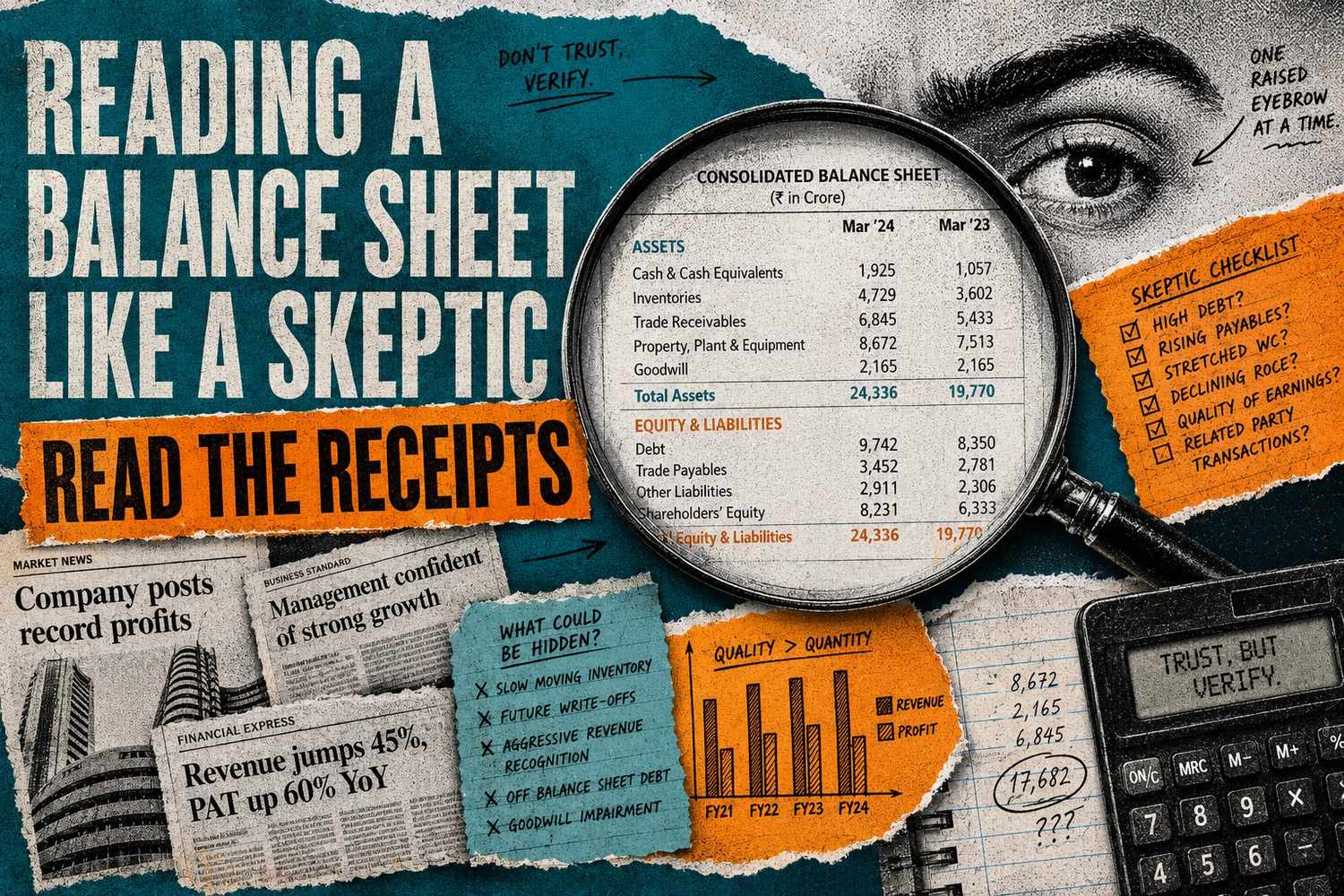
most people who “read” an annual report read the letter at the front, the one where the CEO explains why a hard year was actually a year of building foundations. it is the most confidently written and the least informative document a company produces. the balance sheet, three sections of numbers nobody reads aloud, is where the truth is kept, mostly because it is the one page that has to add up.
i came to this from accounting, so i’ll admit a bias. i think the balance sheet is the most honest page in the whole report. not because numbers can’t lie, they can, and we’ll get to that, but because they have to reconcile, and the effort of making them lie leaves marks. a good skeptic isn’t looking for the lie. they’re looking for the marks.
the mindset before the method
the first thing to change isn’t what you read, it’s how you read it. most people open a report wanting to be convinced. they’ve already half-decided they like the company and they’re looking for permission. that’s the exact wrong posture. you want to read like an auditor who assumes nothing, or better, like someone who will have to defend this position to a person who thinks you’re wrong. read to disprove your own thesis. if it survives that, you might actually have something.
with that in mind, here’s how i actually move through the three lines that matter.
line one: how much of this is real cash?
a company can report a great profit and still be quietly drowning, because profit is an opinion and cash is a fact. profit involves choices, when to recognise revenue, how to spread out a cost, what to assume about the future. cash involves none of that. it’s either in the account or it isn’t.
so the first thing i look for is the gap between the two. is the business turning its reported earnings into actual money, or is the “profit” tied up in receivables it hasn’t collected and inventory it hasn’t sold? one great year of divergence can be timing. a pattern of profit rising while cash from operations doesn’t follow is a question you should ask very loudly, because it’s the single most common shape of a company that looks healthier than it is.
line two: who actually owns this company?
debt isn’t bad. leverage is a tool, and used well it’s how good businesses compound faster. but debt is a promise, and promises come due at the worst possible time. so i look at how much the company owes, when it’s due, and whether the business throws off enough cash to service it without the market’s cooperation.
the test i use is a small thought experiment: if credit markets froze for two years and this company couldn’t borrow a single rupee, would it survive on its own cash flows? the businesses that can answer yes are a different species from the ones that need constant refinancing to look healthy. one kind owns its future. the other rents it, month to month, from lenders who can change their minds.
a company that depends on cheap money staying cheap isn’t a business with a good year. it’s a bet on interest rates wearing a business’s clothes.
line three: what’s hiding in “goodwill” and “other”?
the vaguest lines are where i slow down. big goodwill balances usually mean the company bought other companies for more than they were worth on paper, sometimes wisely, often not. it’s the accounting record of optimism. when that optimism turns out to be wrong, it gets written off in one ugly quarter, and management always frames it as a one-time event, as if the money wasn’t real.
a large and growing “other assets” or “other liabilities” line is an invitation, not an answer. it’s the company telling you there’s something here it didn’t feel like giving its own row. that’s exactly where you go read the footnotes, which is the part of the report that stops performing and starts confessing. the front letter is written by the marketing team. the footnotes are written by the lawyers, and lawyers are careful for a living.
the lie detector, not the math test
here’s the part people miss. reading a balance sheet well is not about arithmetic. the arithmetic is easy. it’s about judgment, about noticing when a company quietly changes how it describes itself. when it shifts how it recognises revenue, that’s a sentence. when it starts capitalising costs it used to expense, that’s a sentence. when “adjusted” earnings drift further and further from actual reported earnings, year after year, that’s a whole paragraph, and it is rarely a happy one.
none of this requires genius. it requires being unimpressed. the letter at the front is written to make you feel something. the balance sheet does not care how you feel, and that indifference is exactly what makes it trustworthy.
why the skeptics quietly win
the fans read the story. the skeptics read the numbers and cross-check them against the story. over one report that difference means little. over a hundred, the skeptics own dramatically fewer disasters, and in investing, avoiding disasters is most of the job. you don’t need to find the one line that reveals fraud. you need to notice, again and again, when the confident version at the front doesn’t quite match the quiet version at the back, and to weight the quiet version more.
that’s the whole discipline. read to disprove. trust cash over profit. treat debt as a promise and footnotes as a confession. you won’t catch everything. but you’ll stop being the last person in the room to find out that a company you admired was never as good as its own letter said it was.
Comments
Likes and comments turn on once your Supabase keys are added — see the relaunch guide.