The psychology of "cheap"
Why a discount feels like value even when it isn't, and how anchoring quietly runs most of the decisions we think we're making rationally.
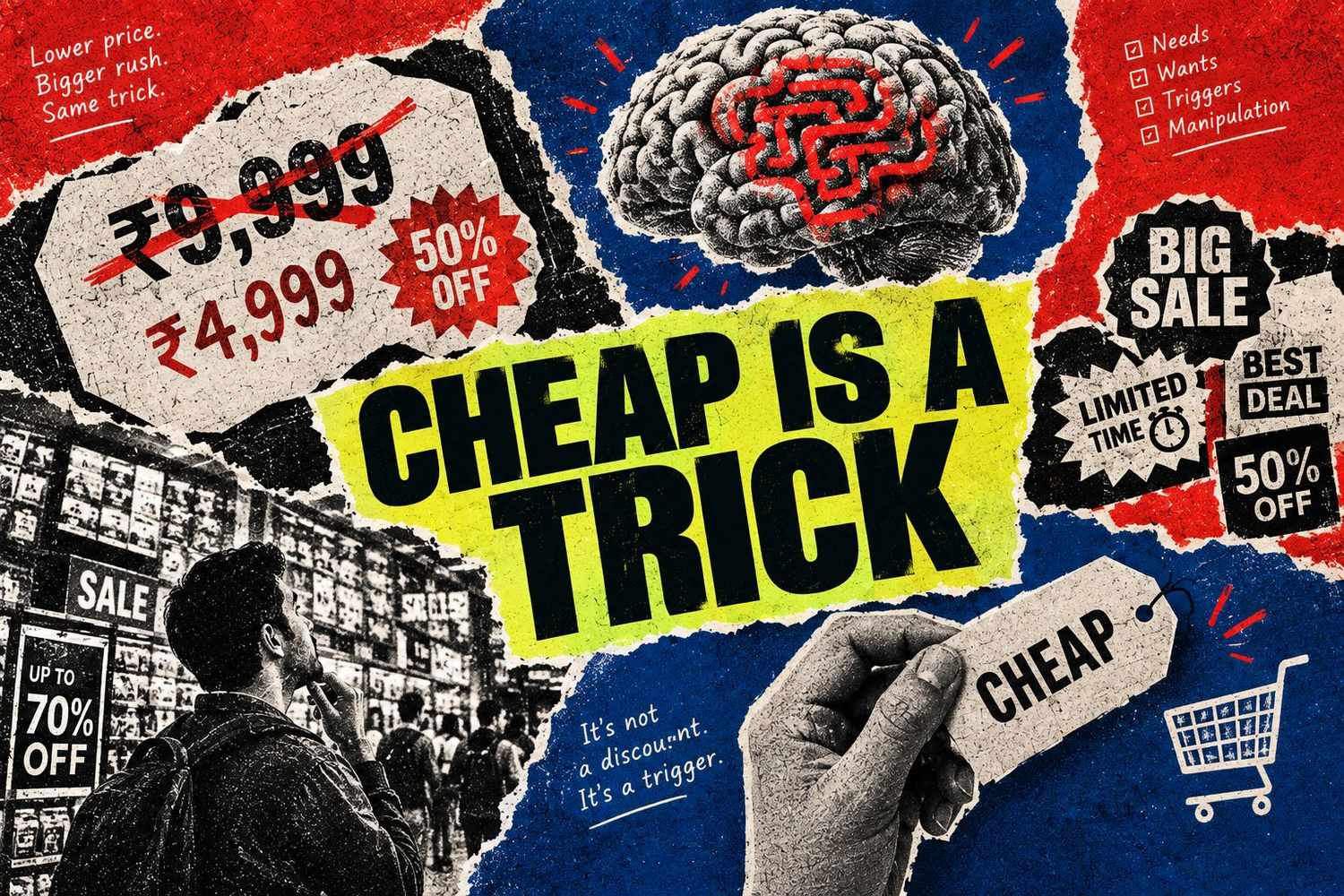
there’s a word that switches off people’s judgment faster than almost any other: cheap. a stock is “cheap.” a deal is a “steal.” a thing is “fifty percent off.” and the moment that word appears, we stop asking the only question that matters, cheap compared to what, and just feel the pull. i find this fascinating, because it isn’t stupidity. it’s a feature of how everyone’s mind works, mine very much included, and understanding it is worth more than any single investing tip.
the anchor does the work
behavioural economists call it anchoring, and it’s brutally simple. the first number you see becomes the reference point for everything after, whether or not it means anything. a shirt marked “was 4,000, now 1,999” feels like value because 4,000 is doing all the work, even if the shirt was never really worth 4,000 and the “was” price exists purely to make the “now” feel good. the crossed-out number isn’t information. it’s a tool, aimed at you, and it works even when you know exactly how it works, which is the unsettling part.
markets run on this constantly. a stock that fell from 1,000 to 400 feels cheap, because 1,000 is the anchor. but 1,000 was just a number a crowd once agreed on, and crowds are wrong all the time. it tells you nothing about what the business is actually worth. the stock could be a genuine bargain at 400 or still wildly overpriced, and the fall tells you almost nothing about which. yet “it’s down sixty percent” makes it feel like a deal, and that feeling moves real money out of real accounts.
price is not value, and the gap is where you get hurt
the antidote is boring and it’s the same one value investors have preached forever: separate price from value. price is what a thing is tagged at. value is what it’s actually worth to own or use. a discount only matters if the value genuinely exceeds the price, and the value has nothing to do with the crossed-out number sitting next to it.
when i catch myself thinking something is cheap, i now force the second half of the sentence. cheap relative to what it will earn? cheap relative to what i’d happily pay if there were no “was” price at all, if i were seeing it for the first time with no anchor? usually the honest answer deflates the excitement, which is exactly its job. the anchor is trying to get you to compare against the wrong thing. naming the comparison out loud breaks the spell, most of the time.
“cheap” is a comparison wearing the costume of a fact. the whole trick is getting you to accept the anchor without noticing you did.
it runs in both directions
here’s the part people miss, because they think anchoring only makes them overspend. the same bias makes us avoid things that have gone up. a higher price feels “expensive” against the anchor of what it used to cost, even when the business is now genuinely worth far more than it was. so we refuse to buy a great company because we “missed it” at a lower price, as if the old price we anchored on were the real one and the market were simply wrong to have moved. we sell our winners too early because they feel expensive relative to what we paid, and we hold our losers too long because selling means admitting the anchor was wrong. both mistakes trace back to the same broken reference point.
you can’t delete it, so manage it
i want to be honest about the limit here. you do not get to switch anchoring off. it’s not a bug you can patch with willpower; it’s closer to an optical illusion, and knowing it’s an illusion doesn’t make the lines look equal. i still feel the pull of “fifty percent off” exactly as strongly as i did before i knew the word for it.
what you can do is build a small habit around the moment. treat the word “cheap,” in your own head or in someone’s pitch, as a little alarm. not a signal to act, a signal to stop and ask what, exactly, you’re comparing to, and whether that comparison was chosen by you or handed to you by whoever benefits from the sale. most of the time, once you name the anchor out loud, its grip loosens. that’s not sophistication. it’s just refusing to let a crossed-out number do your thinking for you, which turns out to be a surprising amount of what separates people who keep their money from people who don’t.
Comments
Likes and comments turn on once your Supabase keys are added — see the relaunch guide.