What running an entertainment center taught me about money
Spreadsheets are clean. A real venture with fixed costs and a slow Tuesday is not, and that gap is the whole education.
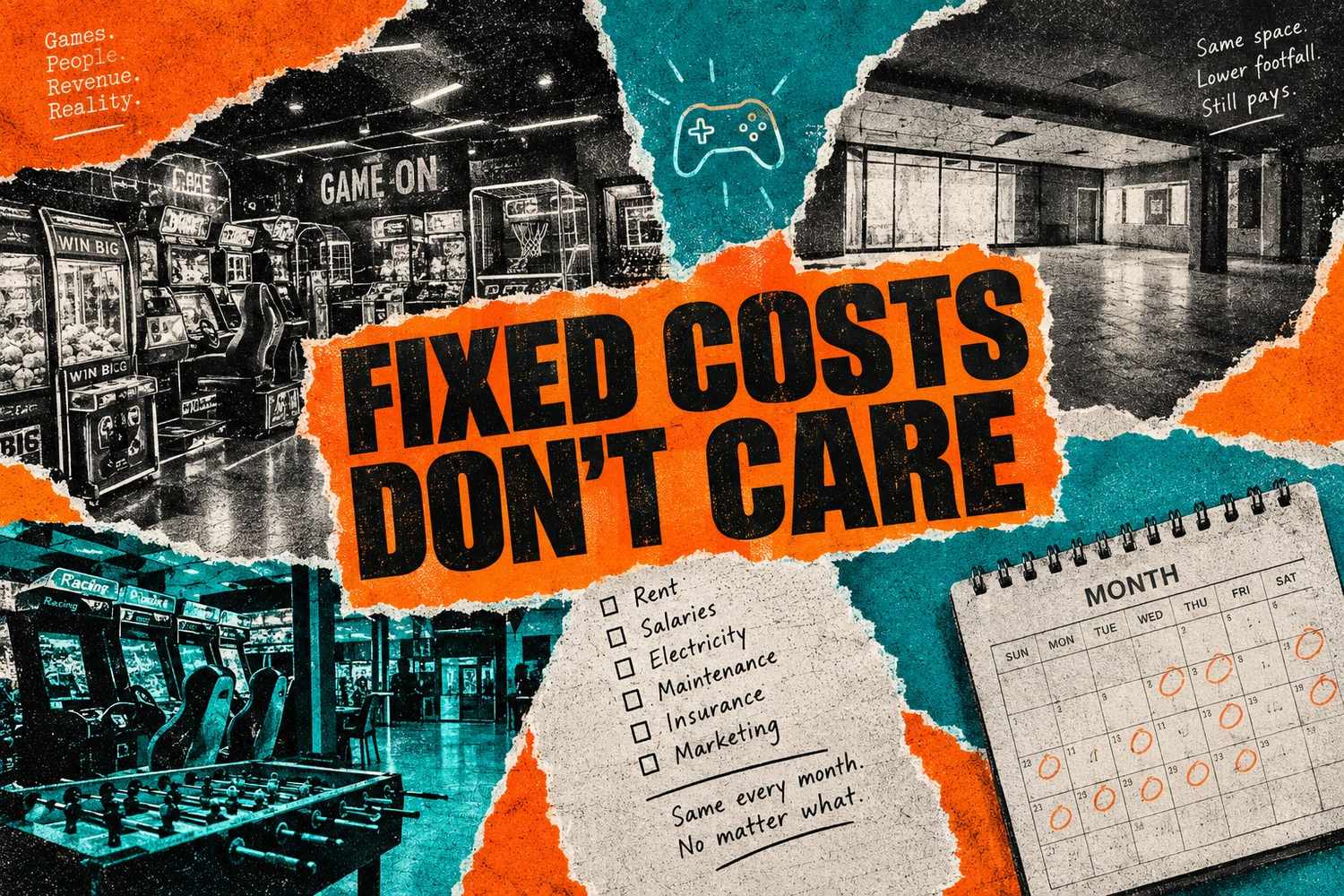
you can learn a lot of finance from books. you learn a different kind of finance from being on the hook for a place that has to open its doors whether or not anyone walks in. i’ve had a stake in a small entertainment venture, and it taught me things no textbook framed the way reality did, mostly because the textbook never made me feel the number in my stomach.
the biggest lesson is embarrassingly simple: fixed costs don’t care how your day is going.
the tyranny of the fixed cost
rent is due. staff get paid. the electricity that runs the lights and the machines runs whether the floor is packed or empty. these costs arrive every month with total indifference to your revenue. on a good weekend they’re trivial, a rounding error against the takings. on a dead Tuesday they’re terrifying, because they keep ticking while nothing comes in to meet them.
what this does to your brain is subtle and permanent. you stop thinking about revenue as “money in” and start thinking about it as “money above the line i have to clear before i’ve earned anything at all.” break-even stops being an accounting term and becomes the number you’re doing mental arithmetic toward at six in the evening, watching the door, calculating how many more people need to walk in before the day stops costing you money and starts making it.
operating leverage, felt instead of read
there’s a phrase for this that sounds dry until you’ve lived it: operating leverage. it just means that when most of your costs are fixed, small changes in revenue produce large changes in profit, in both directions. the same structure that makes a busy month feel euphoric makes a slow one feel like the floor is opening. you are not running a business so much as riding an amplifier.
the textbook draws this as a clean line. in real life it’s the difference between a month where you quietly reinvest and a month where you’re moving money around to make payroll, and the line between those two outcomes is often just a couple of slow weekends you couldn’t control. a festival that pulled everyone elsewhere. a road dug up outside. rain. the amplifier doesn’t distinguish between bad luck and bad management. it just amplifies.
in a fixed-cost business you don’t get paid for being busy. you get paid for being busy enough, consistently, and the gap between those is where owners lose sleep.
footfall is a cash-flow problem wearing a fun disguise
the thing that keeps a place like this alive isn’t a great month. it’s the absence of a catastrophic one. a business with heavy fixed costs lives and dies on the consistency of footfall, because a single bad stretch can eat the buffer that three good months built. survival is less about your ceiling and more about your floor.
so you learn to obsess over the boring levers that raise the floor. can we smooth demand across the week instead of praying for weekends? can we get people to prepay, so cash arrives before the cost does, which quietly turns customers into a source of working capital? can we turn a one-time visitor into someone who comes back, which is worth far more than a new face because we already paid to acquire them once? none of these are glamorous. all of them are the actual business.
the lesson that transferred to everything else
here’s what surprised me. this didn’t just make me a better operator, it made me a better investor. now when i look at a company, i don’t only read the profit. i ask what its fixed costs are and how volatile its revenue is, the same two questions the floor drilled into me. a business with high fixed costs and lumpy revenue is a beautiful thing when times are good and a trap when they aren’t, and i can feel that trade-off in a way i simply couldn’t when it was a line on a page.
airlines, cinemas, gyms, hotels, factories running below capacity: they’re all versions of that dead Tuesday, scaled up. once you’ve sweated a single break-even number in your own venture, you read those businesses differently. you stop being impressed by a good quarter and start asking what happens to them in a bad one, because you know, in your body, how fast the amplifier turns.
running something real doesn’t hand you more facts. it teaches you which facts have teeth. fixed costs have teeth. i respect them now in a way i never did from the safe side of a spreadsheet, and honestly, that respect has protected me from more bad decisions than any amount of reading ever did.
Comments
Likes and comments turn on once your Supabase keys are added — see the relaunch guide.