The market doesn't owe you a story
Every crash gets a tidy narrative after the fact. Waiting for the story is how most people lose money, here's what to watch instead.
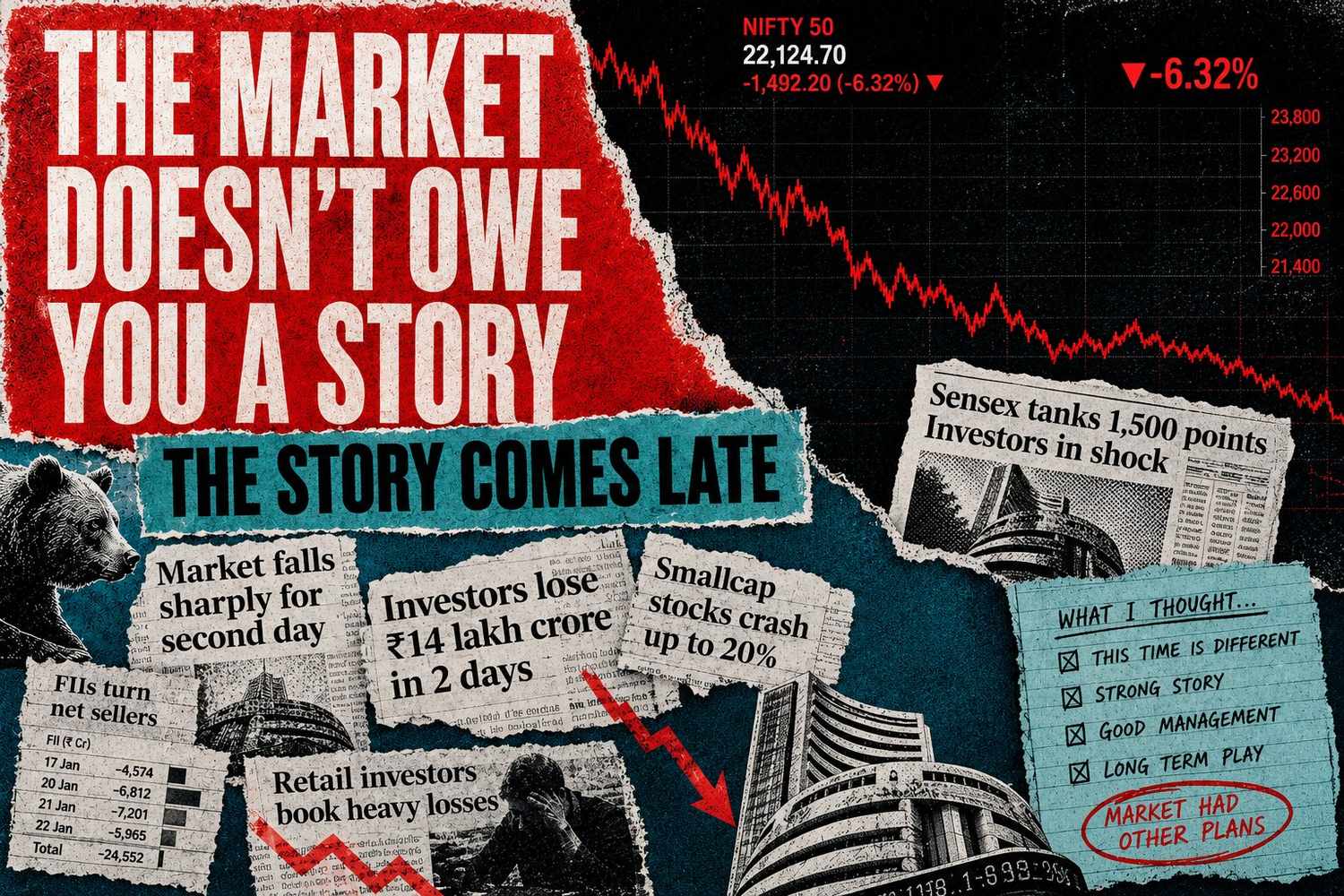
there’s a comfortable lie we tell ourselves about markets: that if we just read enough, we’ll understand why something happened before it hurts us. but the explanation almost always shows up after the price has already moved. the story is a receipt, not a forecast, and we keep mistaking one for the other.
i’ve watched this play out with friends who trade. a stock drops nine percent and within an hour there are twelve threads explaining exactly why, each one confident, most of them contradicting each other. by the time the “reason” is clean enough to repeat at dinner, the money has already been made or lost. the narrative didn’t help anyone act. it helped everyone feel like the world still makes sense, which is a real service, just not a financial one.
why the narrative always lags
prices move on the marginal buyer and seller, the one person who changed their mind today and was willing to transact on it. narratives move on consensus, which by definition needs a crowd to agree. so the story is structurally late. it cannot be otherwise. by the time enough people agree on why a thing happened, the people who caused it to happen have already done their trading and moved on.
this is also why the confident explanations are so often wrong. they are reverse-engineered. something moved, and then a reason was found to fit it, because “it moved and nobody really knows why” is a terrible headline and an even worse feeling. we are pattern-matching animals living in a world that runs partly on noise, and we would rather hold a wrong story than sit with no story at all. the market is happy to sell us that comfort at full price.
the difference between a reason and a cause
here’s a distinction that took me embarrassingly long to see. the news gives you reasons. reasons are things that sound like they should matter: an interest rate decision, a war, an earnings miss. causes are the actual flows of money that moved the price. sometimes they overlap. often they don’t. a stock can fall on “rate fears” while the real cause is one large fund quietly rebalancing for reasons that have nothing to do with the company at all.
you can’t see the causes. that’s the uncomfortable part. all you get are the reasons, dressed up after the fact. so the honest position is not “i understand why this moved.” it’s “i have a story that fits, and i should hold it loosely.”
if you only act once the explanation feels obvious, you’re trading against everyone who acted while it still felt uncertain.
the question that actually helps
i’ve mostly stopped asking “why did it move?” and started asking “what would have to be true for this to keep moving?” the first question is about the past and feels productive. you can research it, read about it, sound smart. the second is about the future and is genuinely useful, even when the honest answer is “i don’t know.”
that second question forces you to name your assumptions out loud. if a stock ran up on the idea that a company will grow revenue thirty percent a year for five years, you can at least ask whether that has ever happened before, whether the market it sells into is even that big, whether the margins survive that kind of growth. none of it tells you what happens tomorrow. but it tells you whether you own a business or a mood, and that is most of the game.
what this looks like in practice
it makes you slower, and slower is usually right. when something i own drops and my first instinct is to go hunting for the reason, i’ve learned to treat that instinct as a signal that i’m looking for comfort, not information. the useful move is to go back to the thing i wrote down when i bought it, the actual case, and ask whether anything in it has changed. most of the time nothing has. the price moved and the business didn’t. those are different facts and the market constantly tempts you to confuse them.
the flip side matters too. sometimes the story arrives and the business really has changed, and then the honest thing is to update, not to defend the position because you’re attached to it. the discipline isn’t stubbornness. it’s refusing to let a headline do your thinking, in either direction.
the part nobody wants to hear
the market will never hand you a story in time to use it. that’s not a flaw you can research your way around. it’s the shape of the thing. information gets priced as it arrives, and by the time it’s a narrative you can repeat, the arriving is done.
so what’s left for a normal person? cash flows, not headlines. whether the business can fund itself without the constant kindness of strangers. whether the thing that made it work last year still works this year. boring, slow, and far more predictive than any thread, because it measures the actual machine instead of the crowd’s mood about the machine.
i still read the stories. they’re interesting, and occasionally one contains a genuine fact worth knowing. but i’ve stopped treating them as instructions. the sooner you accept that the explanation is always late, the sooner you can get on with the far less exciting work of understanding what you actually own, and holding it, or selling it, for reasons of your own.
Comments
Likes and comments turn on once your Supabase keys are added — see the relaunch guide.